Contenido del artículo
For centuries, the mesmerizing depth of a fine blue sapphire has captivated royalty, collectors, and jewelry lovers alike. Whether you are searching for an unforgettable engagement ring or an heirloom-quality investment, navigating the gemstone market requires an understanding of how these stones are valued. Unlike white diamonds, which follow a highly standardized pricing structure, colored gemstones operate on a shifting matrix of rarity, beauty, and geographical history.
This blue sapphire price guide will demystify the market, breaking down the exact variables that dictate the market value of these exceptional gems so you can navigate your next purchase like an industry insider. Use this sapphire buying guide to understand the balance of color, clarity, origin, and treatments before you invest.
1. The 4Cs of Sapphire Quality
While the 4Cs (Color, Clarity, Cut, and Carat Weight) were originally popularized for diamonds, they apply just as strictly to sapphires—though with a vastly different set of priorities.
by Logan Voss (https://unsplash.com/@loganvoss)
Color: The Ultimate Value Driver
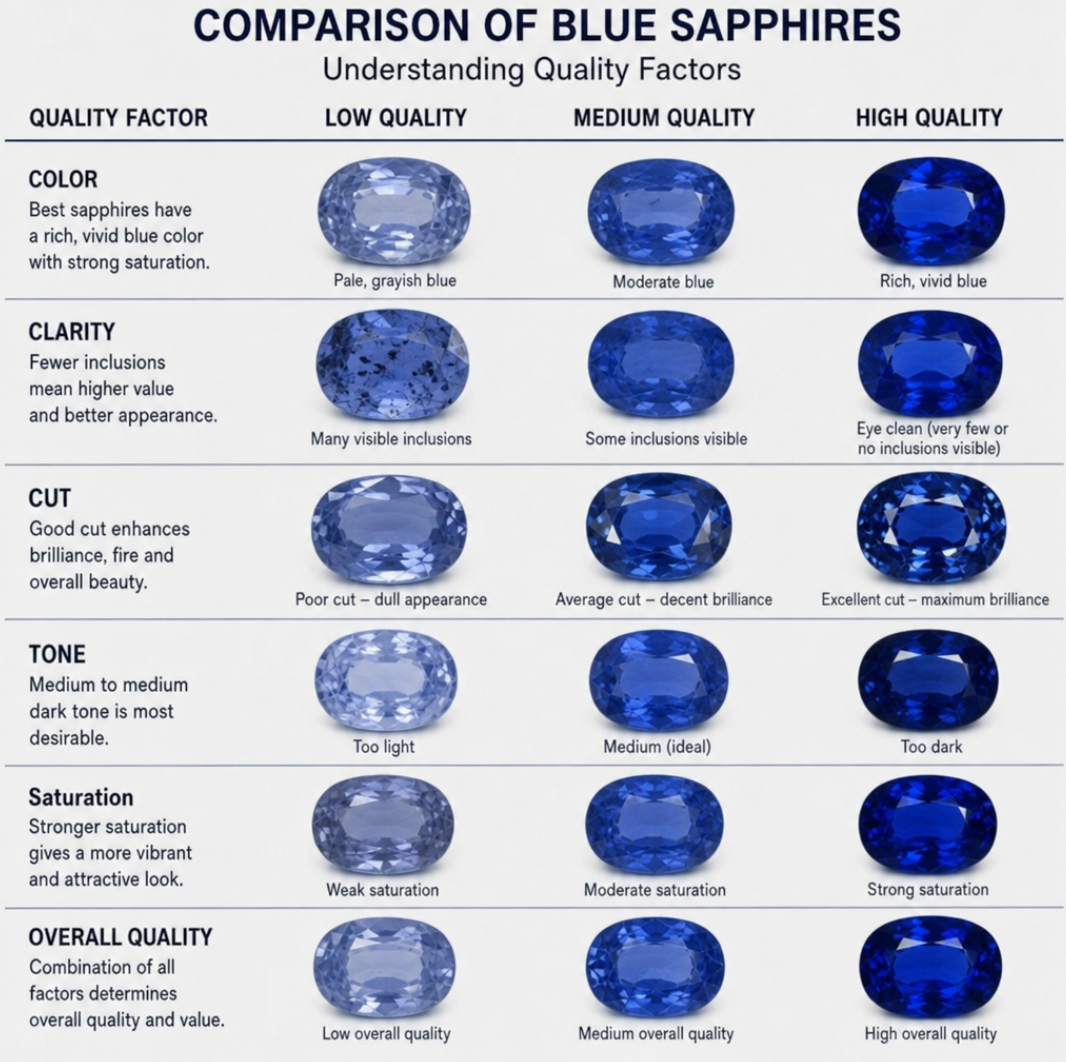
In the colored gemstone world, color is king, accounting for roughly 60% of a stone's total market value. Gemologists break color down into three distinct dimensions:
Hue: The primary color of the gemstone, along with any secondary undertones. While a pure, vibrant blue is the most prized, many sapphires display subtle hints of violet or green. A slight violet secondary hue can add a beautiful warmth, whereas a strong green undertone generally depresses the stone's value.
Tone: This refers to how light or dark the sapphire is. The most valuable fine sapphires sit comfortably in the medium to medium-dark range. If a stone is too light, it may look washed out; if it is too dark (often resembling navy or midnight blue), it loses its ability to return light and will sell at a lower price point.
Saturation: This measures the intensity and vividness of the color. Top-tier trade terms like "Royal Blue" (a deep, highly saturated, velvety blue) and "Cornflower Blue" (a bright, slightly silky blue with an ethereal inner glow) command massive premiums because their saturation remains blindingly vibrant without ever looking dark or dull.
Clarity: Accepting "Silk"
Unlike diamonds, which are judged under 10x magnification for absolute purity, sapphires are graded on an "eye-clean" baseline. Because corundum (the mineral family that includes sapphire and ruby) grows under immense geological pressure, nearly all natural sapphires feature tiny internal inclusions.
The most common inclusions are microscopic rutile needles, known affectionately in the trade as "silk". Remarkably, while heavy inclusions that disrupt transparency or threaten durability will slash a sapphire's price, a light, evenly dispersed dusting of silk can actually elevate value. This silk scatters light internally, giving legendary stones their signature velvety, glowing texture.
by Ahmadreza Rezaie (https://unsplash.com/@ahmdrzarzai)
Cut: Maximizing Brilliance and Weight
When a lapidary (gem cutter) sits down with a piece of rough sapphire, their primary goal is to preserve as much weight as possible while optimizing the face-up color. Because sapphire rough is incredibly valuable, you will rarely see perfectly symmetrical "ideal" cuts like those found in diamonds.
Instead, look for a balanced cut that prevents "windowing"—a flaw where the center of the stone is cut too shallow, causing light to leak through like a clear pane of glass rather than bouncing back to your eye. A well-cut sapphire will display even brilliance across its entire surface.
Carat Weight: Exponential Pricing Jumps
Sapphire pricing does not scale linearly; it scales exponentially. A high-quality 3-carat blue sapphire will not simply cost three times more than a 1-carat stone of identical quality—it can easily cost five to eight times more per carat. Large, gem-quality sapphire crystals are extraordinarily rare anomalies of nature, resulting in steep price spikes whenever a stone crosses major psychological milestones like the 2-carat, 5-carat, or 10-carat thresholds.
2. The Power of Geographic Origin
Where a sapphire was mined plays a massive role in its prestige and ultimate pricing. Certain historical mining regions have achieved legendary status due to the specific visual characteristics born from their unique geological conditions:
Kashmir: The undisputed pinnacle of luxury sapphire history. Mined high in the Himalayas during a brief window in the late 19th century, Kashmir sapphires are famous for their unmatched, cornflower-blue "velvety" appearance. Because the mines have long been exhausted, these stones are incredibly scarce museum pieces, routinely commanding auction prices from $20,000 to over $100,000 per carat.
Burma (Myanmar): Renowned for producing exceptionally rich, highly saturated "Royal Blue" stones. Fine, untreated Burmese sapphires hold an esteemed spot among international collectors and command a significant premium over most other origins.
Sri Lanka (Ceilán): Sri Lanka es el corazón histórico del comercio mundial de zafiros, donde se producen gemas brillantes de color azul aciano y azul pastel. Los zafiros de Ceilán logran un equilibrio perfecto entre tradición histórica, un brillo intenso y una relativa accesibilidad.
Madagascar: Una potencia moderna en el mundo de las gemas. Descubiertos a finales de la década de 1990, los yacimientos de Madagascar producen zafiros deslumbrantes que pueden rivalizar visualmente con los mejores de Ceilán y Birmania. Debido a que carece del prestigio histórico centenario de Sri Lanka, un zafiro de Madagascar de buena calidad suele ofrecer una excelente relación calidad-precio, con un precio entre un 20 % y un 30 % inferior al de un ejemplar idéntico procedente de una fuente más antigua.
 3. Estado del tratamiento: Natural vs. Mejorado
En el mercado actual de piedras preciosas, la transparencia en cuanto a los tratamientos es fundamental. Aproximadamente el 90% de todos los zafiros se someten a un tratamiento térmico antes de llegar a las tiendas.
[Natural, completamente sin tratar] --> Premium ultrarraro (cuesta entre 3 y 4 veces más)
[Tratamiento térmico tradicional] --> Estándar de la industria (ampliamente aceptado)
[Difusión reticular/berilio] --> Descuento por valor severo (50%-80% menos)
[Vidrio de plomo/Relleno de fracturas] --> Grado comercial bajo (Valor mínimo)
El tratamiento térmico tradicional imita suavemente los procesos geotérmicos naturales de la Tierra, disolviendo pequeñas inclusiones para mejorar permanentemente la claridad y la saturación del color de la piedra. Este es un estándar de la industria totalmente aceptado que produce piedras preciosas, duraderas y de alta calidad para joyería.
Sin embargo, el 10% restante de los zafiros que se extraen de la tierra con un color y una claridad impresionantes, sin ninguna intervención humana, son verdaderos milagros geológicos. Un zafiro natural de alta calidad, sin tratamiento térmico, puede alcanzar fácilmente un precio entre un 100% y un 300% superior al de una piedra idéntica tratada térmicamente.
Advertencia: Desconfíe de las piedras de bajo costo que han sido sometidas a tratamientos químicos agresivos, como la difusión de berilio en la red cristalina o el relleno de vidrio fracturado, ya que reducen drásticamente su valor intrínseco. Exija siempre un certificado independiente de un laboratorio autorizado, como el Instituto Gemológico de América (GIA), para verificar el historial exacto de tratamientos de la piedra.
Cómo encontrar tu zafiro azul perfecto
En definitiva, elegir un zafiro de calidad se reduce a encontrar el equilibrio entre tus preferencias estéticas y tu presupuesto. Tanto si te enamoras de un azul aciano vibrante de Ceilán como de un azul real birmano profundo y aterciopelado, comprender las variables técnicas del mercado protege tu inversión y te garantiza encontrar una gema que te brindará alegría durante generaciones.
¿Listo para descubrir una gema excepcional que se ajuste exactamente a tu visión, o necesitas que un experto analice un informe de laboratorio independiente? Estamos aquí para guiarte en cada paso del proceso de selección. Trabajemos juntos para hacer realidad la joya de tus sueños: Contáctanos hoy mismo en Oria Gems .
Referencias y fuentes autorizadas
Instituto Gemológico de América (GIA): Factores de calidad del zafiro y guía del comprador
Sociedad Internacional de Gemas (IGS): Valor, precio e información sobre joyería del zafiro
La Compañía del Zafiro Natural: Precios y tendencias del mercado del zafiro