محتوى المقال
When you look at a blue sapphire, a vivid ruby, or a glowing yellow sapphire, you are seeing more than a beautiful colour. You are seeing the result of complex interactions between light and the material inside the gemstone.
Some gems owe their colours to tiny amounts of chemical elements. Others depend on defects within their crystal structures. Still others display colour because of the way light interacts with their internal structure.
Understanding these mechanisms does more than satisfy curiosity. It helps gem buyers understand why gemstones look the way they do, why treatments matter, and why two stones of the same variety can have very different appearances and values.
Let’s explore the science behind gemstone colour.
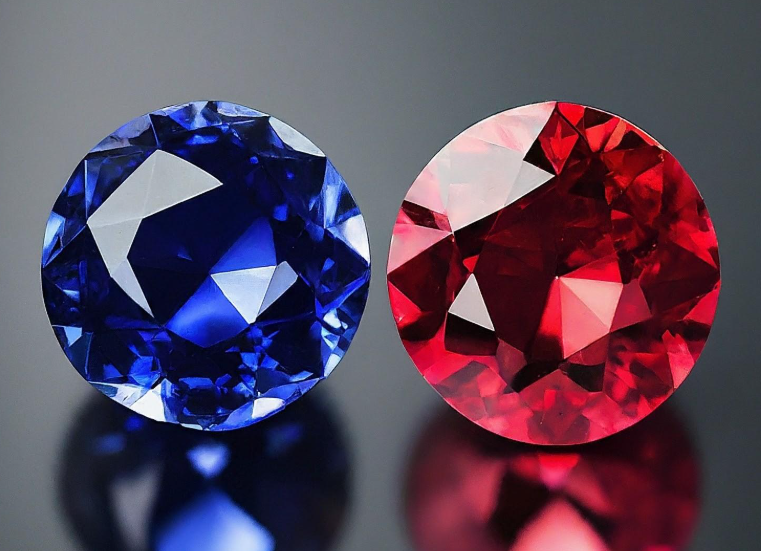
Ruby and blue sapphire showing different colors of corundum
1. The Science of Gemstone Colour: What Do We Actually See?
White light contains a range of visible wavelengths, from violet and blue to green, yellow, orange, and red.
When light enters a gemstone, some wavelengths may be absorbed while others are transmitted, reflected, or scattered. The combination of light that reaches your eyes determines the colour you perceive.
For example, a blue sapphire appears blue because its material selectively absorbs parts of the visible spectrum while allowing more blue light to reach the observer.
However, colour is not determined by chemistry alone. Crystal structure, inclusions, transparency, cut, lighting conditions, and viewing angle can all influence a gemstone’s appearance.
So, what determines which wavelengths a gemstone absorbs?
Gemologists study several mechanisms, three particularly useful categories being trace-element absorption, colour centres, and broader electronic or structural effects. Optical phenomena, such as the play-of-colour in precious opal, provide another important example of how a gemstone can display colour.
2. Mechanism One: Trace Elements
One of the most familiar causes of gemstone colour is the presence of small amounts of other elements within a mineral’s crystal structure.
These elements may replace some of the atoms normally present in the crystal. Even small concentrations can significantly change how the material interacts with light.
Corundum is an excellent example.
Pure corundum is aluminium oxide (Al₂O₃). It is normally colourless, but trace elements and their interactions can produce a remarkable range of colours.
How trace elements create different colours
These are simplified explanations. The precise colour mechanism can vary with the gemstone’s composition, growth environment, and treatment history.
Ruby: The power of chromium
Ruby and sapphire are both varieties of corundum. The traditional distinction is primarily based on colour: red corundum is ruby, while other corundum colours are classified as sapphire.
Chromium ions replacing aluminium ions are primarily responsible for ruby’s red colour. Their interaction with light produces the characteristic red appearance associated with fine rubies.
The concentration and distribution of chromium, together with other factors, influence the final appearance.
Blue sapphire: Iron and titanium
The blue colour of many sapphires is associated with interactions between iron and titanium in the crystal structure.
These elements can produce charge-transfer absorption, removing selected wavelengths from the transmitted light and creating the familiar blue appearance.
Not every blue sapphire has exactly the same chemistry, and the balance of elements, inclusions, and optical properties can produce different shades of blue.
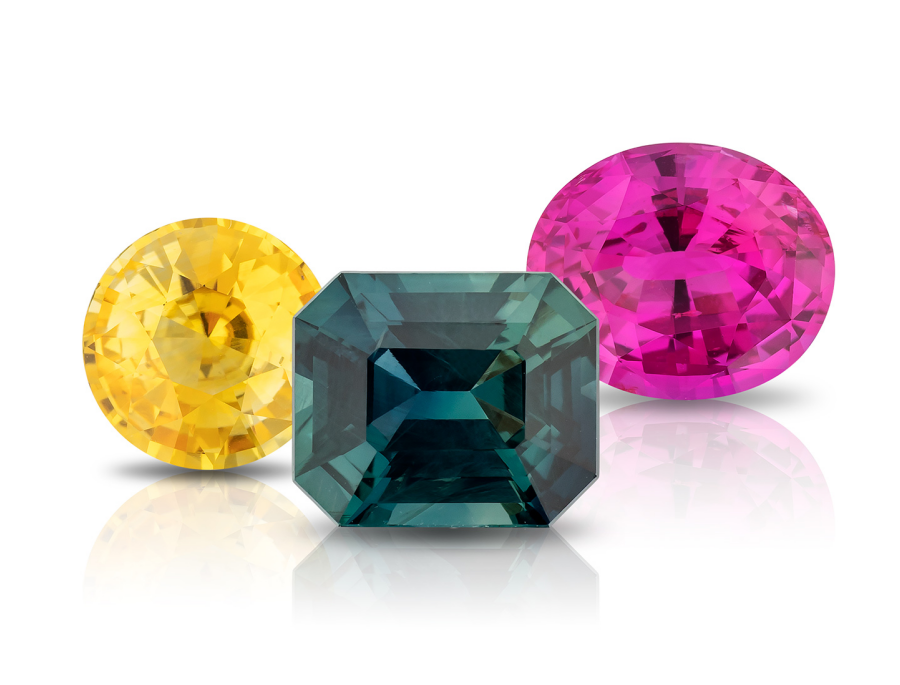
Yellow sapphire and Padparadscha
Yellow sapphire is another example of how subtle chemical differences can produce a completely different colour. Iron-related mechanisms play an important role, although the precise process can be more complex than the simple presence of iron.
Padparadscha is especially interesting because its distinctive pinkish-orange to orangy-pink colour reflects a combination of factors rather than one simple ingredient. Its accepted colour range and stability are important considerations when determining whether a stone qualifies as Padparadscha.
The key lesson: a gemstone’s colour can reveal clues about its chemistry, but colour alone cannot establish its origin, treatment status, or authenticity.
3. Mechanism Two: Colour Centres and Crystal Defects
Not every gemstone gets its colour from a straightforward substitution of one element for another.
Sometimes, the explanation lies in the crystal’s electronic structure.
A colour centre is a defect or arrangement within a material that changes how it absorbs light. Such centres can involve vacancies, impurities, trapped electrons, or electron holes.
These structures can absorb particular wavelengths, changing the colour we see.
Amethyst: Why quartz becomes purple
Amethyst is the purple variety of quartz, a mineral composed primarily of silicon dioxide (SiO₂).
Iron impurities and radiation-related changes in the crystal’s electronic structure play important roles in producing its purple colour. The mechanism is more complex than simply saying that an electron becomes trapped, but the underlying principle is that the crystal’s electronic state changes its absorption of light.
Heating can alter or weaken amethyst’s colour, and some amethyst can turn yellow or another colour under suitable conditions.
This is why colour should not automatically be treated as proof of a gemstone’s natural history.
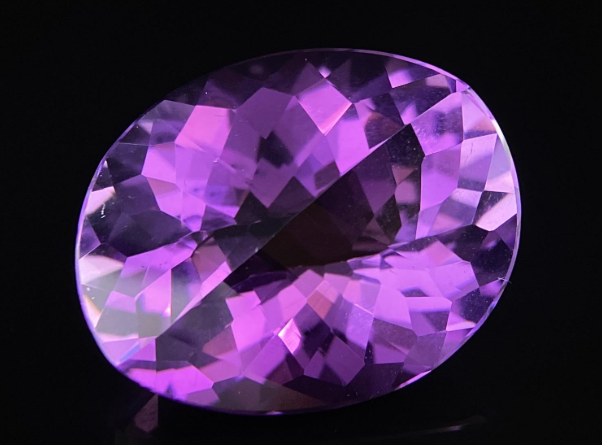
Purple amethyst quartz gemstone close-up
Blue topaz: A useful treatment example
Blue topaz provides another important lesson.
Strong blue topaz commonly owes its colour to irradiation treatment, sometimes followed by heating. These processes alter the material’s colour-producing defects and electronic structure.
The resulting blue colour is generally stable under normal wearing conditions, although appropriate care is still necessary, particularly around high temperatures.
This distinction matters: a gemstone can be genuine natural topaz while having a colour that was produced or enhanced after mining.
Natural origin and natural colour are not the same claim.
4. Mechanism Three: Electronic and Structural Effects
Some gemstone colours arise from more complex interactions involving the crystal’s electronic structure, including combinations of impurities and defects.
Yellow diamonds offer a good example. Their colour is commonly associated with nitrogen-related impurities and defects in the diamond lattice.
When these structures absorb more strongly toward the blue end of the visible spectrum, the remaining light can make the diamond appear yellow.
However, nitrogen alone does not automatically produce a strong yellow colour. Its concentration and arrangement within the crystal are important.
Different arrangements of nitrogen-related defects can produce different optical properties, which is one reason coloured diamonds are scientifically fascinating.
In practice, gemologists study the precise absorption features and other characteristics of a stone rather than relying on a simplified explanation based on a single element.
5. A Different Route to Colour: Optical Phenomena
Some gemstones display colour because of how light interacts with microscopic structures inside the material.
Precious opal is one of the best-known examples.
Its characteristic play-of-colour is caused by the diffraction of light by regularly arranged, microscopic silica spheres. The arrangement and size of these spheres determine which spectral colours become visible.
As the viewing angle or illumination changes, flashes of colour may appear to move across the stone.
This differs from the selective absorption responsible for many ruby and sapphire colours.
Opal is therefore a useful reminder that not every colourful gemstone follows the same physical process.
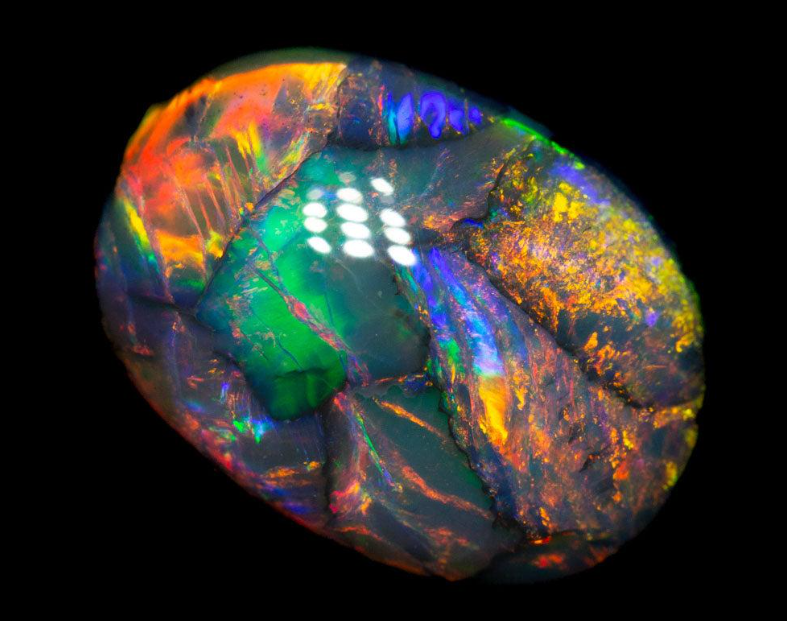
Precious opal displaying a rainbow play of color
6. Compare the Main Colour Mechanisms
These categories are a practical learning framework, not four completely separate scientific boxes. Some gemstones involve several mechanisms at once.
7. Workflow: From Crystal Chemistry to the Colour You See
The process can be simplified into the following sequence:
Mineral formation
↓
Crystal structure develops
↓
Trace elements, defects, or microscopic structures influence light
↓
Selected wavelengths are absorbed, transmitted, or diffracted
↓
The gemstone displays its characteristic colour or optical effect
↓
Cut, lighting, viewing angle, and treatment history influence its final appearance
This workflow explains why two gemstones from the same mineral family can look so different.
It also explains why visual inspection alone cannot reliably determine whether a gemstone is untreated or whether its colour will remain stable under every condition.
8. Why Colour Mechanisms Matter When Buying Gemstones
Understanding colour is useful, but buyers need to go one step further: they need to distinguish the origin of a gemstone’s colour from its treatment history and stability.
Natural colour does not automatically mean permanent colour
Some naturally occurring colours are stable under ordinary conditions. Others can change when exposed to heat, light, or other environmental factors.
Treatments can also alter colour stability. For example, certain colour changes induced in sapphires are unstable, while many irradiated blue topaz stones retain their colour well during normal use.
Therefore, it would be misleading to say that all trace-element colours are permanent or that all colour-centre colours are unstable.
The answer depends on the material, the particular colour mechanism, and any treatments the stone has received.
Three questions to ask before buying
Is the gemstone natural or laboratory-grown? This establishes how the material originated.
Has it been treated? Heat treatment, irradiation, diffusion, and other processes can affect appearance and value.
How stable is the colour? Ask whether the colour is expected to remain stable under normal wear and whether any special care is necessary.
For higher-value stones, an independent gemological laboratory report can help establish identity and disclose detectable treatments. The appropriate level of testing depends on the stone and the claims being made.
A trustworthy seller should communicate what is known about the gemstone clearly, without making unsupported promises.
9. Frequently Asked Questions
Why do two sapphires have different colours?
Differences in trace elements, their electronic interactions, crystal defects, and treatment history can produce different colours. Cutting, inclusions, and lighting also affect the appearance.
Is a natural sapphire always untreated?
No. A sapphire can be natural and heat-treated, or it may have undergone another treatment. Natural origin describes how the material formed, not whether it was modified later.
Is Padparadscha simply a pink sapphire mixed with yellow sapphire?
No. Padparadscha is a recognized colour variety of sapphire, with a characteristic pinkish-orange to orangy-pink appearance. Its identification requires more than assuming that two colours have been mixed.
Can a gemstone change colour over time?
Yes, depending on the gemstone and its treatment history. Some colour changes are stable, while others may fade or change under certain conditions. A qualified gemologist or suitable laboratory can help assess specific cases.
Conclusion: Colour Is More Than Appearance
The colour of a gemstone is the visible result of its chemistry, crystal structure, electronic properties, and interaction with light.
Chromium helps explain the red of ruby and the pink of many sapphires. Iron-related mechanisms contribute to yellow sapphire, while iron and titanium interactions help explain many blue sapphires. Amethyst demonstrates the importance of defects and electronic states, and precious opal reveals how microscopic structures can create spectacular optical effects.
For gemstone buyers, the most important lesson is simple: understanding a gemstone’s colour is only the beginning. Its natural origin, treatment history, colour stability, and overall quality all deserve attention.
At Oria Gems, we believe informed buyers make better gemstone decisions. Whether you are sourcing sapphire, ruby, yellow sapphire, Padparadscha, or other natural coloured gemstones, you can explore our available inventory at shop.oriagems.com. For wholesale enquiries, product information, or help sourcing stones for your business, please contact the Oria Gems team.
References and Further Reading
Gemological Institute of America (GIA), A Quantitative Description of the Causes of Color in Corundum.
GIA, Sapphire Quality Factors.
GIA, Yellow Sapphire: Natural, Heat-Treated, Beryllium-Diffused, and Synthetic.
GIA, Opal Description.
GIA, Naturally Colored Yellow and Orange Gem Diamonds: The Nitrogen Factor.
Cheng, R. and Guo, Y., Study on the effect of heat treatment on amethyst color and the cause of coloration, Scientific Reports, 2020. Read the peer-reviewed study.