محتوى المقال
Aquamarine is one of those gemstones that feels instantly calming — a cool breath of ocean air captured in crystal form. But behind its serene beauty lies a surprisingly complex world of grading, valuation, and gemological nuance.
If you’ve ever wondered why some aquamarine pieces cost a few hundred dollars while others reach five‑figure prices, this guide will walk you through the exact criteria gemologists use to evaluate aquamarine quality.
🌊 1. Color: The First (But Not Only) Indicator of Quality
Color is the most influential factor in aquamarine value — but “deep blue is better” is only partially true.
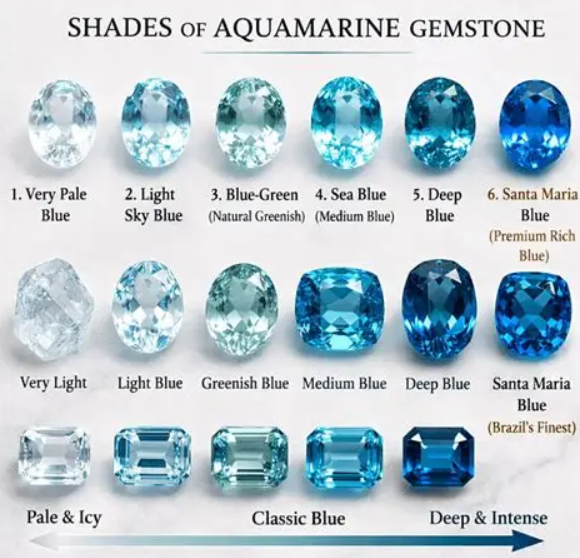
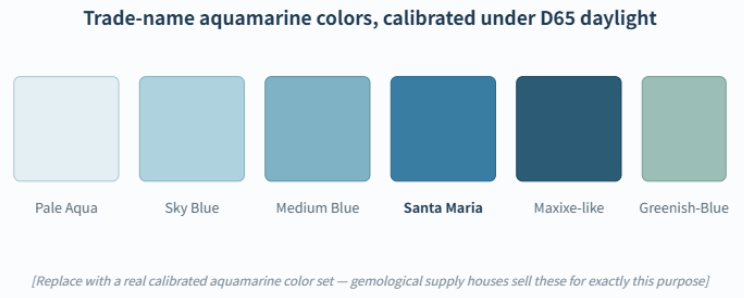
Understanding Aquamarine’s Color Spectrum
Aquamarine ranges from:
Pale icy blue
Sky blue
Seafoam blue‑green
Medium blue
Deep saturated blue (Santa Maria)
Is Deep Blue Always Better?
Generally, yes — deeper blues command higher prices because they are rarer. But gemologists also consider:
Hue (Is the blue pure or greenish?)
Tone (How light or dark is the stone?)
Saturation (How intense is the color?)
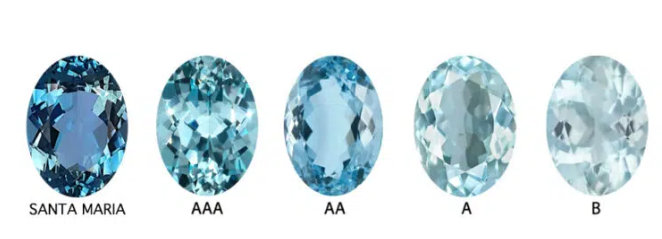
A medium‑blue aquamarine with excellent clarity and cut can be more valuable than a deep‑blue stone with visible inclusions.
What About Greenish Aquamarine?
Historically, aquamarine often had a greenish tint. Today, most consumers prefer pure blue, but collectors still appreciate natural green‑blue stones for their vintage charm.
💎 2. Clarity: Why “Eye‑Clean” Matters
Aquamarine is part of the beryl family, which tends to form with excellent clarity. Most high‑quality aquamarine is “eye‑clean,” meaning no inclusions are visible without magnification.
Common Aquamarine Inclusions
Liquid inclusions
Two‑phase inclusions
Hollow tubes
Minute crystals
How Clarity Affects Value
Eye‑clean stones = higher value
Visible inclusions = lower value
Heavily included stones = often used for beads or carvings
Clarity becomes especially important for larger stones, where inclusions are easier to spot.
✂️ 3. Cut: The Hidden Factor That Changes Everything
Even a beautifully colored aquamarine can look dull if poorly cut.
What Gemologists Look For
Symmetry
Light performance
Proportions
Polish quality
Popular Aquamarine Cuts
Emerald cut
Oval
Cushion
Pear
Portuguese cut (for maximum sparkle)
A well‑cut aquamarine enhances color, hides minor inclusions, and increases brilliance — all of which raise value.
🧭 4. Origin: Why “Santa Maria” Aquamarine Is So Famous
If you’ve ever heard the term Santa Maria aquamarine, you might assume it refers to a specific mine. Historically, it did — the Santa Maria de Itabira mine in Brazil produced some of the world’s deepest blue aquamarine.
What “Santa Maria” Means Today
Because the original mine is depleted, “Santa Maria” has become a color grade, not strictly an origin. It refers to:
Deep, vivid blue aquamarine
High saturation
Exceptional rarity
Santa Maria Value
Santa Maria stones can be:
3–10× more expensive than standard aquamarine
Highly sought after by collectors
Often found in premium jewelry pieces
Other notable origins include:
Madagascar (similar deep blues)
Pakistan (lighter but very clean stones)
Nigeria (wide color range)
🔍 5. How to Identify Real Aquamarine (Like a Gemologist)
With aquamarine’s popularity rising, imitations are becoming more common. Here’s how professionals distinguish real aquamarine from fakes.
Gemologist‑Approved Identification Methods
Check refractive index (RI: 1.577–1.583)
Observe pleochroism (blue + slightly greenish blue)
Look for natural inclusions
Test hardness (7.5–8 on Mohs scale)
Examine color zoning
Common Aquamarine Imitations
Blue topaz
Glass
Synthetic spinel
Dyed quartz
If you’re unsure, always request a GIA or IGI certificate.
Three common aquamarine impersonators show up in the trade. Quick-diagnostic table:
📘 Aquamarine Quality Comparison Sheet
🔧 Gemologist Workflow: How Aquamarine Is Evaluated
Initial Visual Inspection
↓
Color Grading (Hue, Tone, Saturation)
↓
Clarity Assessment (Inclusions, Transparency)
↓
Cut Evaluation (Symmetry, Light Return)
↓
Origin Consideration (Brazil, Madagascar, Nigeria)
↓
Final Value Determination (Market Demand + Rarity)
🌟 So… Is Deep Blue Always Better?
Deep blue aquamarine is rare, beautiful, and valuable — but it’s not the only measure of quality. A gemologist looks at the entire picture: color, clarity, cut, origin, and authenticity.
A pale‑blue aquamarine with exceptional clarity and a masterful cut can be just as desirable as a deep‑blue stone. Ultimately, the “best” aquamarine is the one that speaks to you.
If you’d like help choosing the right aquamarine or want expert guidance on custom jewelry, feel free to reach out through our Contact page — our CAT (Customer Assistance Team) is always here to help you find a gemstone you’ll treasure.
Authoritative References
Gemological Institute of America (GIA) – Aquamarine Gemstone Guide
American Gem Trade Association (AGTA) – Beryl Mineral Family Overview
International Gem Society (IGS) – Aquamarine Grading & Identification
Smithsonian National Museum of Natural History – Aquamarine Mineral Data