Article Content
Quick read. Spinel used to hide inside royal crowns under the wrong name. Today it is the gem collectors actually argue about at shows. This guide walks through where the best spinel comes from, why Mahenge red looks electric next to a calm Ceylon pink, how cutters treat each origin, and what pushes a stone's price from $80/ct to $8,000/ct. About 10 minutes to read, written for buyers and collectors, not gemologists.
What is spinel, and why does anyone care?
Spinel is a magnesium aluminium oxide (MgAl₂O₄). It sits at 7.5–8 on the Mohs scale, harder than garnet, softer than sapphire, fine for daily wear in a protected ring setting. It is singly refractive, which gives a clean, glassy look that people often mistake for synthetic until they see the price tag.
For centuries Europe's most famous "rubies" were actually spinel. The 170-carat Black Prince's Ruby on the British Imperial State Crown is one. The 352-carat Timur Ruby is another. The trade back then didn't have refractometers; the stones were never deliberate fakes, just unidentified rarities. Burmese dealers had always called the brightest red ones balan. When Mahenge rough hit global markets around 2007 with neon-pink output, the gem stopped being a footnote and started getting its own pavilion at shows.
Where fine spinel comes from
Spinel deposits are rarer than people assume. Five places account for most of the gem-quality material on the market today.
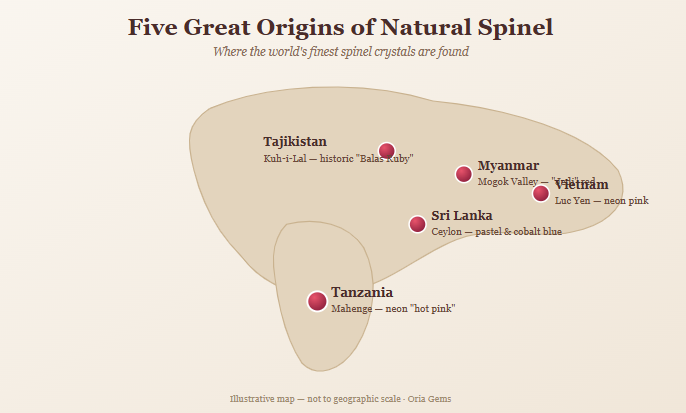
Myanmar (Mogok, Namya). The reference origin. Mogok reds lean slightly violet with a silky daylight glow. Namya, in Kachin State, produced much of the vivid hot pink that reached the trade in the 1990s and 2000s.
Tanzania (Mahenge). The locality that put spinel on the modern map. Stones here carry low iron and a fluorescence that reads as "neon." Cutters keep Mahenge rough shallow and broad; deep pavilions kill the effect.
Vietnam (Luc Yen). Famous for cobalt-blue spinel that closely mimics fine Kashmir sapphire. Vietnamese blues reach saturated, slightly greyish tones and trade at a strong premium.
Sri Lanka (Ceylon). The traditional balance point: pastel pinks, lavenders, occasional soft reds. Clarity is usually high; saturation is usually gentle. Ceylon stones match cleanly in calibrated sizes.
Tajikistan and Madagascar. Smaller in volume. Tajikistan produces strong red and pink with a slight orange undertone; Madagascar covers a broad colour range.
Jeddah / Mahenge vs Ceylon at a glance
"Jeddah spinel" is a trade label, not a mine. Jeddah is the Arabian trading hub where a lot of African and Asian rough is sorted before being shipped to cutters in Thailand, India, or China. So a "Jeddah" stone on a dealer's site is most often a Mahenge or Madagascar piece that passed through Saudi Arabia on its way to a faceting workshop. That detail matters for price, not for the gem itself.
| Origin | Signature colour | Typical clarity | Cutting style | Price band (1–3 ct, top quality, 2025) |
|---|---|---|---|---|
| Mahenge (Tanzania) | Neon red, hot pink | Eye-clean to lightly included | Shallow, broad pavilion | $1,500 – $8,000 / ct |
| "Jeddah" (traded, origin-labelled) | Same range as Mahenge / Madagascar | Varies | Depends on cutter, often Thai | Labelled Mahenge/Madagascar commands a premium over generic "Jeddah" |
| Myanmar (Mogok, Namya) | Classic red, slightly violet | Often lightly included | Slightly deeper than Mahenge | $2,000 – $12,000 / ct (especially unheated reds) |
| Vietnam (Luc Yen) | Cobalt blue, violet-blue | Usually clean | Standard brilliant, often precision cut | $1,200 – $5,000 / ct |
| Sri Lanka (Ceylon) | Pastel pink, lavender, soft red | Very clean | Standard brilliant, calibrated sizes common | $200 – $1,200 / ct |
| Tajikistan | Red, orange-pink | Variable | Standard brilliant | $400 – $2,000 / ct |
Indicative wholesale range for natural, untreated stones; prices track colour saturation more than carat weight in spinel.
The spinel colour chart
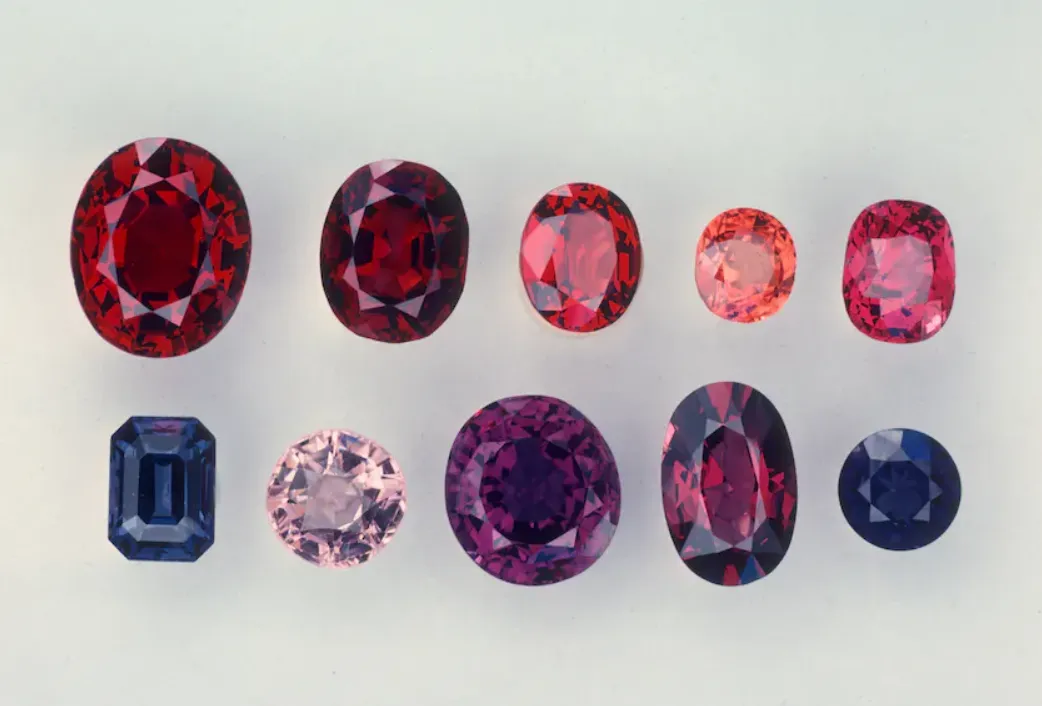
Most buyers picture a red gem when they hear "spinel." That is true to history, but only to a small slice of the picture. Spinel grows in nearly every colour corundum grows in, plus a few corundum skips entirely. Cobalt blue, lavender, violet, hot orange, peach, brownish-pink, and pitch black all show up on dealer trays. The most expensive stones right now sit in a narrow band of vivid red-pink with strong fluorescence; the second tier is vivid cobalt blue.
Sheet 2 — Spinel colour families collectors actually shop by
Vivid red
Mahenge, Mogok, Tajikistan. The reference grade.Hot / neon pink
Mahenge's signature. Low iron, high fluorescence.Pastel pink
Ceylon's everyday output. Calm, clean, wearable.Lavender / mauve
Ceylon and Madagascar. Often overlooked, quietly collectable.Cobalt blue
Luc Yen, Vietnam. Cobalt-bearing, no iron grey.Violet / purple
Mogok and Sri Lanka. Sits between blue and red stones.Orange / padparadscha-like
Madagascar and Tanzania. Genuinely rare; pairs well with rose gold.Black
Used in men's jewellery and inlay. Cheap per carat, opaque.
What actually moves the price
Five factors, in roughly this order of weight:
Colour saturation. A flat, washed-out red sells for less than a smaller vivid red. Pastels have their own market and shouldn't be ranked against vivids as if they were the same gem.
Fluorescence and "neon" feel. This is what separates a $300/ct Mahenge pink from a $4,000/ct Mahenge pink. The effect comes from low iron, and you read it by tilting the stone under a daylight lamp.
Origin paperwork. A GIA, Gübelin, or AIGS origin report for Mahenge, Mogok, or Luc Yen can lift the price of an otherwise ordinary stone by 30–80%. Stones without origin reports are sold as "colour only."
Clarity. Spinel forms in octahedral crystals and is usually cleaner than ruby. Eye-clean stones are common at retail; loupe-clean stones command a premium under 2 carats.
Cut. Native cut on Mahenge rough was historically too deep; modern precision cutting from the 2010s onward produced stones with much better light return. A well-cut stone looks brighter, larger, and "cleaner" than its specs suggest.
Treatments matter less than they do for ruby. Spinel is rarely heated in any commercial quantity. Most stones on the market are taken out of the ground, faceted, and that's it. If a report says "no indications of heating," that is closer to the norm than the exception.
From mine to a stone on a dealer's tray
The path a piece of rough takes before it reaches a jeweller's showcase is the same path almost every fine spinel has walked since 2007. Worth knowing, because origin stories on listings start here.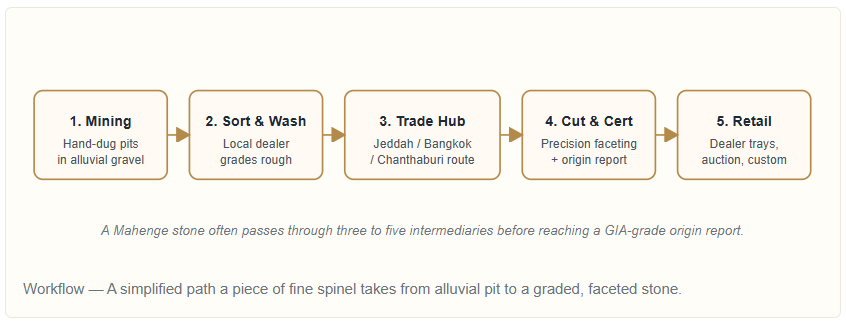
Why collectors treat spinel differently now
Three reasons. Supply from any one locality can drop sharply when a vein runs out, and new material rarely matches what came before. The price gap between common Ceylon pink and top Mahenge red has widened enough that collectors treat each tier as a different market. And unlike sapphire or ruby, spinel is essentially never treated, so authenticity questions resolve faster and with more confidence.
Practical upshot: a Mahenge stone with an origin report can be resold into a recognised collector market at a price that has real liquidity behind it. Pastel Ceylon stones are harder to monetise that way but easier to wear every day. Different gem, different strategy.
A short checklist before you commit
Ask for the origin report. GIA, Gübelin, AIGS, or Lotus Gemology resell cleanly.
Confirm weight to two decimal places and dimensions in millimetres. Spinel is priced by carat, but collectors also price by spread.
Look at the stone under a daylight lamp (6500 K). Office fluorescents flatten colour and hide fluorescence.
Ask about heating. The honest answer is usually "no," and an evasive answer is a red flag.
If a stone is over 3 ct and priced like Ceylon pastel, ask twice where it actually came from.
Closing
Spinel rewards a buyer who knows which question to ask before paying: where did this stone actually come from, and is that origin documented? Once those two answers are solid, the rest is taste.
If you have a specific stone in mind, or want a second opinion on a listing you've been considering, send the report and a daylight photo to the Oria Gems desk. We look at rough and cut stones every week from Mahenge, Mogok, Luc Yen, and Ceylon, and we'll tell you straight whether the price matches the piece. Get in touch with us here — we read every enquiry ourselves.
References and further reading
Gemological Institute of America (GIA). Spinel Description. GIA Gem Encyclopedia. gia.edu/spinel-description
Gübelin Gem Lab. Spinel: From the Crown Jewels to the Trade. Gübelin Gem Lab journal articles.
International Gem Society (IGS). Spinel Buying Guide. gemsociety.org/article/spinel-jewelry-and-gemstone-information/
Lotus Gemology. From Kashmir to Cobalt: A Spinel Spectrum. Lotus Gemology field reports on Mahenge, Luc Yen, and Mogok.
American Gemological Laboratories (AGL). Spinel Origin Reports: Methodology and Caveats. AGL documentation.
Hughes, R.W., et al. Terra Spinel: The Mahenge Connexion. Gems & Gemology, Vol. 53 (2017).
Pardieu, V. Spinel from Mahenge, Tanzania. Field Gemology reports, GIA / AIGS collaboration.