Introduction: The Truth Behind the Sparkle
Let’s get one thing out of the way:
not all gemstones are as “natural” as they look in those perfectly lit Instagram photos.
Some are straight from the earth, untouched.
Some have had a little “spa treatment” (heat, mostly).
And some… well, they were born in a lab, not underground.
None of this is inherently bad—but if you’re spending real money on gemstones, you deserve to know exactly what you’re buying.
So let’s break it down, properly—but without putting you to sleep.
First Things First: What Are Gemstone Treatments?
In simple terms, gemstone treatments are anything humans do to a stone after it’s mined to make it look better.
That could mean:
· Making the color richer
· Improving clarity
· Fixing what nature didn’t quite finish
Think of it like this:
Some stones wake up flawless. Others need coffee… and a little help.
And yes—treatment directly affects value. A lot.
Natural Gemstones: The “No Filter” Version
These are the purists’ choice.
Natural gemstones are formed over millions of years, deep inside the earth, with:
· No human interference
· No enhancement
· No shortcuts
They often have tiny inclusions (internal features), which gemologists lovingly call “fingerprints of nature.” Translation: proof it’s the real deal.
Why people love them:
· Extremely rare
· High investment value
· Each stone is one of a kind
The honest truth:
Perfect, untreated gemstones are unicorn-level rare—especially in sapphires and rubies.
If you ever see a flawless, vivid, large gemstone at a “too good” price… you already know the answer.
Heated Gemstones: The Industry Standard (Yes, Really)
Now here’s where things get interesting.
Heat treatment is not a shady trick—it’s actually been used for thousands of years. Even ancient traders were heating stones to improve color.
So what does heating actually do?
It’s basically controlled high-temperature treatment that:
· Deepens color
· Improves clarity
· Removes unwanted tones
Think of it as finishing what nature started.
Traditional vs Modern Heating
In places like Sri Lanka, traditional heating methods (often called “Sherry” style heating) involve:
· Clay chambers
· Natural materials
· Careful temperature control
Modern methods use:
· High-tech furnaces
· Precise temperature monitoring
· Repeatable, consistent results
Same goal—different tools.
Is heat-treated bad?
Short answer: No.
Long answer:
· It’s widely accepted in the global gem trade
· It must always be disclosed
· It makes beautiful stones more accessible
The trade-off:
· Less rare than untreated stones
· Slightly lower value (but still very valuable)
If untreated gems are “museum pieces,” heated gems are the luxury you can actually wear daily without needing a security guard.
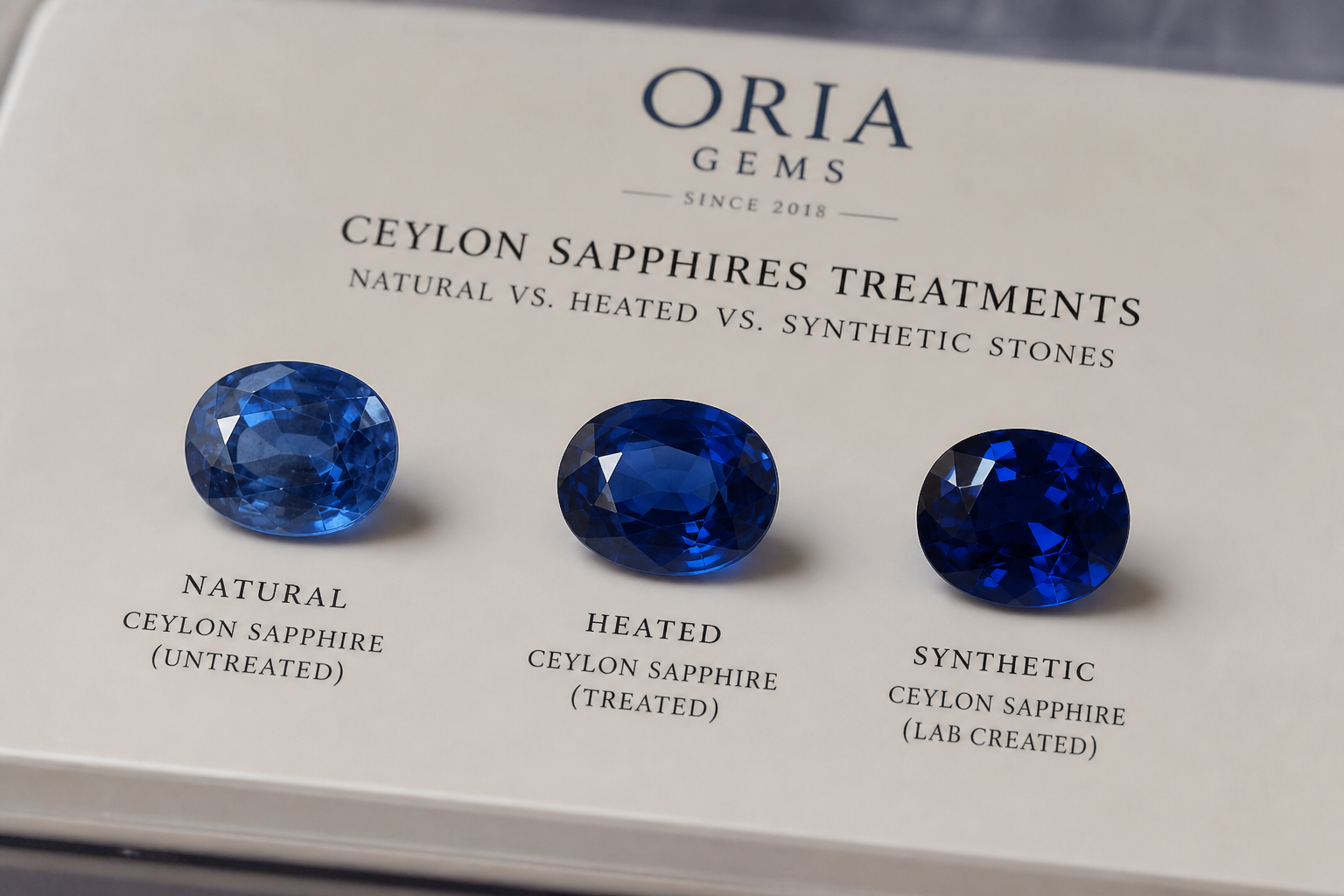
Synthetic Gemstones: Lab-Grown, Not Fake
Let’s clear up a common misunderstanding.
Synthetic gemstones are not fake—they are chemically identical to natural stones.
The only difference?
They’re created in a lab instead of underground.
How they’re made:
Common methods include:
· Flame fusion
· Hydrothermal growth
· Flux growth
Basically, scientists recreate the same conditions that happen in the earth… just much faster.
Why people buy them:
· Much more affordable
· Visually very clean (sometimes too perfect)
· Environmentally appealing to some buyers
What they lack:
· Rarity
· Long-term investment value
· Natural origin story
If natural gemstones are original paintings, synthetics are high-quality prints—beautiful, but not the same thing.
Diffusion Treatment: Where Things Get Tricky
Now we’re entering the part of the conversation where you should pay extra attention.
Diffusion treatment involves adding elements (like beryllium or titanium) into a gemstone during heating to change its color—sometimes dramatically.
What’s the catch?
· The color can be concentrated near the surface
· It may not go all the way through the stone
· It significantly lowers value
And most importantly:
It must be disclosed. Always. No exceptions.
In the fine gemstone world, diffusion-treated stones are generally not considered premium material.
Color-Change Heat Treatment: Subtle but Powerful
Not all heating is about “fixing” a stone—sometimes it’s about fine-tuning it.
This process adjusts internal elements to:
· Shift color balance
· Enhance brilliance
· Improve overall appearance
Examples:
· Sapphires: turning dull blue into vivid royal blue
· Rubies: intensifying red tones
· Spinel: often left untreated (because it’s already stunning)
Done well, it’s almost invisible—but it makes a big difference.
Sheet1. Comparison to Natural and Heated Stones
Feature | Natural | Heated | Synthetic |
Origin | Earth | Earth + treatment | Laboratory |
Rarity | High | Moderate | Low |
Value | Highest | Medium | Lowest |
Appearance | Unique | Enhanced | Often flawless |
So… What Should You Actually Buy?
Here’s the honest, no-sales-pitch answer:
· If you want rarity and investment: go for natural untreated
· If you want beauty + value balance: heated gemstones are your best friend
· If you want affordability: synthetic is a perfectly valid option
The key is not “which is better”—
it’s whether you know what you’re buying.
Final Thoughts: Transparency Is the Real Luxury
In today’s market, the most valuable thing isn’t just the gemstone—it’s trust.
At Oria Gems, we believe:
· Every stone should be clearly disclosed
· Every client should understand what they’re buying
· And no one should feel confused after making a purchase
Because at the end of the day, a gemstone isn’t just about how it looks—
it’s about the story behind it.
And you deserve the real story.
References & Further Reading
· Gemological Institute of America (GIA) – Gemstone Treatments
https://www.gia.edu/gem-treatment
· International Gem Society (IGS) – Gemstone Enhancements
https://www.gemsociety.org/article/gemstone-enhancements/
· American Gem Trade Association (AGTA) – Treatment Codes
https://agta.org
· CIBJO (World Jewellery Confederation)
https://www.cibjo.org
· Gübelin Gem Lab
https://www.gubelin.com